Why the V-Model places lifting systems at the heart of cleanroom design

The V-Model of validation structures the relationship between design and qualification in cleanroom projects. What is often overlooked is that lifting systems already influence this structure at an early stage. Decisions made during functional design determine how smoothly installation, operational and performance qualification will proceed.

ENG V-model

The V-Model as the bridge between design and qualification

In cleanroom projects, the V-Model functions as the bridge between design decisions and qualification outcomes. It connects what is defined during design to what must later be demonstrated during commissioning and qualification.

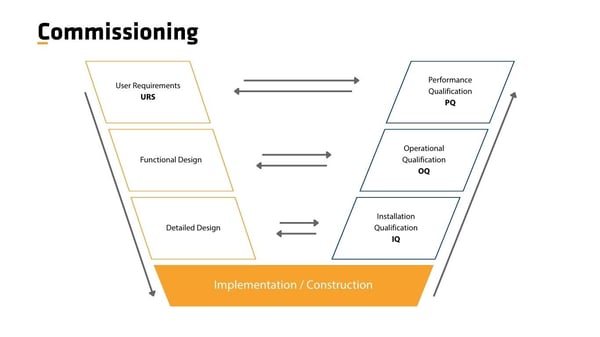
The left-hand side of the V represents the progression from User Requirements to functional design and detailed engineering. At the base lies the construction phase, where the design is realised. The right-hand side covers commissioning and qualification, including Installation Qualification (IQ), Operational Qualification (OQ) and Performance Qualification (PQ).


This structure ensures traceability throughout the project lifecycle. Requirements defined at the top of the V, often captured in a User Requirement Specification (URS), must be demonstrably met during IQ, OQ and PQ within predefined limits. Design choices are therefore not isolated decisions; they directly determine how qualification will be executed and verified.
Why lifting systems often remain out of focus

Lifting solutions such as cleanroom cranes often receive detailed attention only after the cleanroom layout has been defined and major installations are largely fixed. Within the V-Model, they are then implicitly positioned under detailed engineering or even construction.

During the early design phase, the primary focus is typically on the cleanroom environment itself: airflow concepts, classification levels, architectural detailing and building services. Only at a later stage does the discussion shift to the process that will take place within the cleanroom and the equipment and supporting systems required to enable it.

This approach is understandable. However, a stable and reliable process requires more than a properly designed room. The systems that support the process must also be suitable for cleanroom applications and contribute to safeguarding the specified environmental conditions.

A lifting system is therefore not an isolated tool, but part of the process infrastructure. It must support cleanliness, structural stability and controlled movement without compromising cleanroom performance.

When this functional role is not explicitly incorporated into the functional design, the discussion shifts to the execution phase. In the V-Model, the lifting solution then effectively falls under detailed design or construction, while its impact extends to Installation Qualification (IQ), Operational Qualification (OQ) and Performance Qualification (PQ).

The appropriate position of cleanroom cranes within the V-Model

Within the V-Model, lifting systems are not a late-stage addition. Their position lies on the left-hand side of the V, at the stage where process requirements are translated into functional design criteria. This is where their impact can still be defined and controlled.

At this stage, several practical questions require clear answers:
 •  What needs to be lifted, and under which conditions?
 •  How frequently do these lifting movements occur within the process?
 •  What impact may they have on cleanliness levels, vibration behaviour and process stability?
 •  How can maintenance be carried out without affecting cleanroom performance?

Defining these aspects during functional design ensures that lifting systems form part of the project’s formal requirements. Their performance can then be evaluated in a structured manner during Installation Qualification (IQ) and Operational Qualification (OQ), and ultimately confirmed during Performance Qualification (PQ), when the process is validated under defined operating conditions.

Practical example: why spatial decisions influence validation

In a high-tech cleanroom assembly project, it became apparent at a late stage that heavy modules had to be positioned periodically above critical workstations. By that point, the available ceiling height and load-bearing structure were no longer sufficient for the required crane configuration.

This resulted in modifications to the supporting structure and additional risk assessments, with direct consequences for project planning and documentation within commissioning and qualification.

If the lifting function had been defined earlier as part of the User Requirement Specification (URS) and incorporated into the functional design, these considerations would have taken place before detailed engineering and construction.

Design decisions shape qualification outcomes

The V-Model of validation is not merely a QA diagram. It defines how design decisions translate into demonstrable performance during commissioning and qualification.

When lifting systems are embedded in functional design, coherence is created between design, commissioning and qualification. This strengthens validation predictability and prevents late-stage technical modifications during construction.

Early alignment between design and qualification prevents late-stage redesign. Discuss your project with a technical specialist via the contact form below. 

More news

The technical foundations of cleanroom lifting solutions

Specifying a cleanroom crane does not start with lifting capacity, but with insight and technical understanding. Which ISO classification applies? What contamination risks are present? Which material and cleaning requirements must be considered?

Without this foundation, unnecessary risks arise in design, delays in validation and process instability.


That is why we have developed a series of technical whitepapers to support engineers and cleanroom managers in specifying lifting solutions in cleanrooms and controlled production environments.


Read more

What is the lifting range of a cleanroom crane?

Lifting a load is the base of any lifting solution in a cleanroom. To define the right lifting solution, several aspects need to be considered. Two key concepts play a role; the lifting area and the lifting range. How these are defined and applied depends on the type of crane used.

Read more

Why construction meetings are essential for a flawless crane installation

Why construction meetings are essential for a flawless crane installation

Installing a cleanroom crane requires precision—not only in steel, but also in planning. Construction meetings provide the overview needed to identify bottlenecks early and prevent delays.


Read more

More than 25 years of engineering expertise in cleanroom lifting

Since 1888, Mennens has built engineering expertise in lifting technology. Since 2024, Mennens Cleanroom Cranes operates as an independent company, with a clear focus on lifting solutions for cleanrooms and controlled production environments.

In the article below, published in the Mennens magazine, we look back at the origins of Cleanroom Cranes and ahead.

Read more
Back to overview

Get advice

Our experts are ready to assist you.

Contact image 414x414 (1)

Need customization?

Contact image 414x414 (1)

Mennens Cleanroom Cranes B.V.

Achtseweg Zuid 161
5651 GW Eindhoven
The Netherlands
T +31(0)88 425 83 00
sales@cleanroomcranes.nl
www.cleanroomcranes.nl