Stopping systems in cleanroom cranes: defining the limits of the lifting range

A cleanroom crane does not operate in unlimited space. Its movement is confined to a clearly defined lifting range determined by the runway structure and the mechanical design of the system. That range defines where loads may be transported and positioned.

Protecting those boundaries is essential. For that reason, cleanroom cranes are equipped with dedicated stopping systems at the ends of the runway.
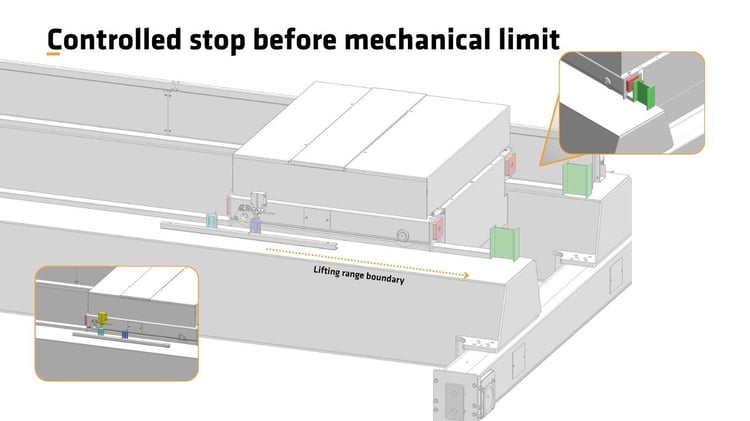
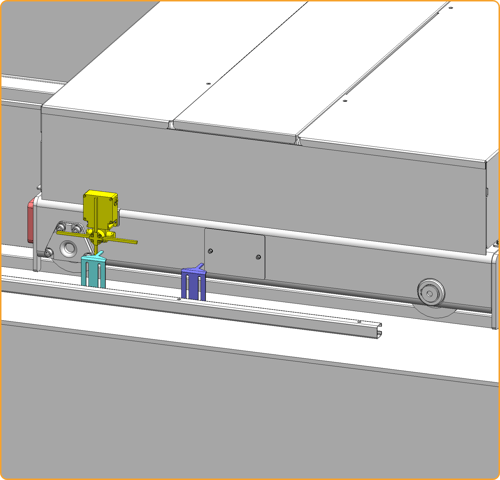
ENG Stopsystem 1

Protecting the boundaries of the lifting range

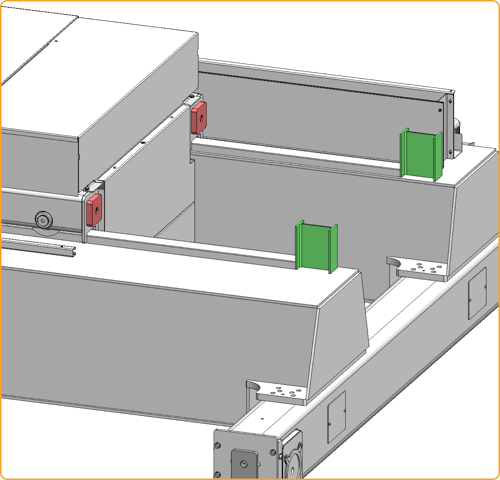
Stopping systems are installed at the outer limits of crane travel. Their purpose is straightforward: to ensure that neither the crane nor the trolley can move beyond the permitted working area.

This protection prevents the crane from;
•  the crane is brought to a controlled halt before reaching the mechanical end stop;
•  keeps loads within the intended lifting range;
•  and safeguards the structural integrity of the system.

In other words, stopping systems are not about avoiding objects within the working area, but about enforcing the limits of that area itself.

Two components, two functions

Although both are located at the end of the runway, the stopping system consists of two distinct elements with different responsibilities.


Limet switch2

Limit switch

The limit switch is activated before the crane reaches the physical end of the runway . When a predefined position within the lifting range is passed, the switch signals the drive system to slow down or stop. This allows the crane to decelerate in a controlled and predictable manner, ensuring that it comes to rest before the mechanical boundary is reached.

In normal operation, the limit switch provides a gradual and precise stop at the limit of the lifting range 

End stop

End stop

The end stop is positioned at the very end of the runway, the end stop defines the crane’s absolute mechanical travel limit. It ensures that movement cannot extend beyond the structurally permitted range.

The end stop is not intended for regular operation, but serves as the final mechanical safeguard of the system.

Reliability within defined limits

By combining controlled deceleration with mechanical restriction, the lifting range is protected in two stages. First, movement is slowed and brought through the limit switch. Only if that controlled stop is exceeded does the end stop come into play.

This layered approach enhances operational reliability and ensures that the crane remains within its designed working area at all times. In cleanroom environments, where predictability and system stability are essential, stopping systems are therefore a fundamental part of the overall crane design.

Do you have questions about lifting range limits or the implementation of stopping systems in your cleanroom crane?
A technical expert can review your application and advise on an appropriate configuration.

Please contact us via the contact form at the bottom of this page.

More news

Lifting systems within the V-Model of cleanroom validation

The V-Model of validation structures the relationship between design and qualification in cleanroom projects. What is often overlooked is that lifting systems already influence this structure at an early stage. Decisions made during functional design determine how smoothly installation, operational and performance qualification will proceed.

Read more

The technical foundations of cleanroom lifting solutions

Specifying a cleanroom crane does not start with lifting capacity, but with insight and technical understanding. Which ISO classification applies? What contamination risks are present? Which material and cleaning requirements must be considered?

Without this foundation, unnecessary risks arise in design, delays in validation and process instability.


That is why we have developed a series of technical whitepapers to support engineers and cleanroom managers in specifying lifting solutions in cleanrooms and controlled production environments.


Read more

What is the lifting range of a cleanroom crane?

Lifting a load is the base of any lifting solution in a cleanroom. To define the right lifting solution, several aspects need to be considered. Two key concepts play a role; the lifting area and the lifting range. How these are defined and applied depends on the type of crane used.

Read more

Why construction meetings are essential for a flawless crane installation

Why construction meetings are essential for a flawless crane installation

Installing a cleanroom crane requires precision—not only in steel, but also in planning. Construction meetings provide the overview needed to identify bottlenecks early and prevent delays.


Read more
Back to overview

Get advice

Our experts are ready to assist you.

Contact image 414x414 (1)

Need customization?

Contact image 414x414 (1)

Mennens Cleanroom Cranes B.V.

Achtseweg Zuid 161
5651 GW Eindhoven
The Netherlands
T +31(0)88 425 83 00
sales@cleanroomcranes.nl
www.cleanroomcranes.nl