How do you choose the right overhead crane for a cleanroom?

Not every overhead crane is suitable for every cleanroom process. The right choice depends on the lifting tasks involved, the available space, cleanliness requirements and the level of positioning accuracy needed during handling operations.

Why overhead cranes are widely used in cleanrooms

Cleanroom floor space is often reserved for production equipment, transport systems and operators. Overhead cranes make it possible to move materials and equipment without taking up valuable floor space, helping to maintain an efficient cleanroom layout.

They also provide a controlled way to move and position loads. This is particularly important in high-tech, semiconductor and pharmaceutical environments, where cleanliness, precision and process stability are critical.

Maximising lifting range within the available space

I n cleanroom projects, available space is often just as important as lifting capacity. Crane systems are therefore designed to make the most of the available cleanroom height by maximising lifting range and usable hook height.

This helps maximise the usable working area without increasing the size of the cleanroom.

Precision and heavy-duty handling

Many cleanroom applications require both high lifting capacity and precise positioning. Modern cleanroom cranes enable heavy modules to be positioned accurately and under full control within critical production and assembly processes.

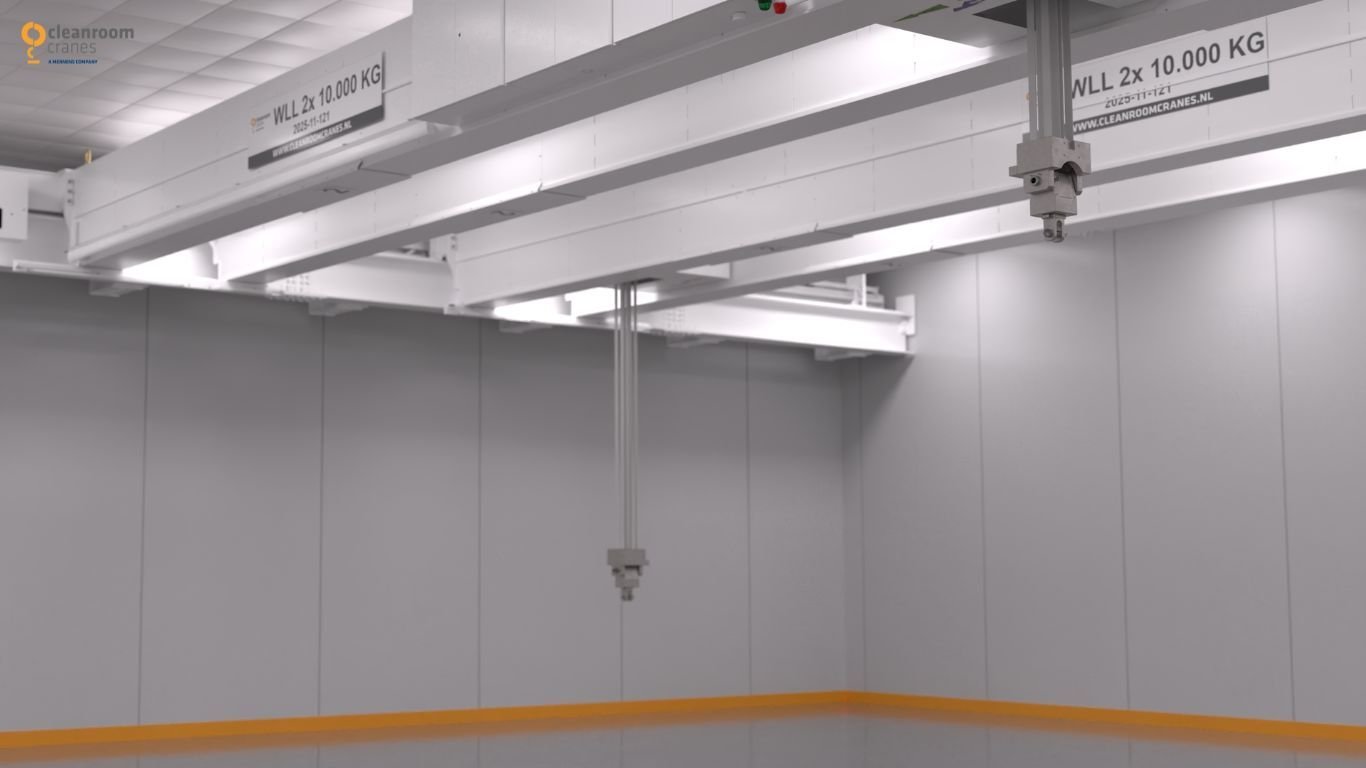
Doublegirder overhead

Single-girder or double-girder?

Both single-girder and double-girder cranes are commonly used in cleanrooms, but they are suited to different situations.

The choice is influenced by factors such as load weight, crane span, required hook height and the available cleanroom height.

In many cleanrooms, height is one of the most important considerations. Because cleanroom space is expensive to build and maintain, they are often designed as compactly as possible. A double-girder crane can often provide greater effective hook height within the same cleanroom envelope, making it a common choice when available lifting height is limited.


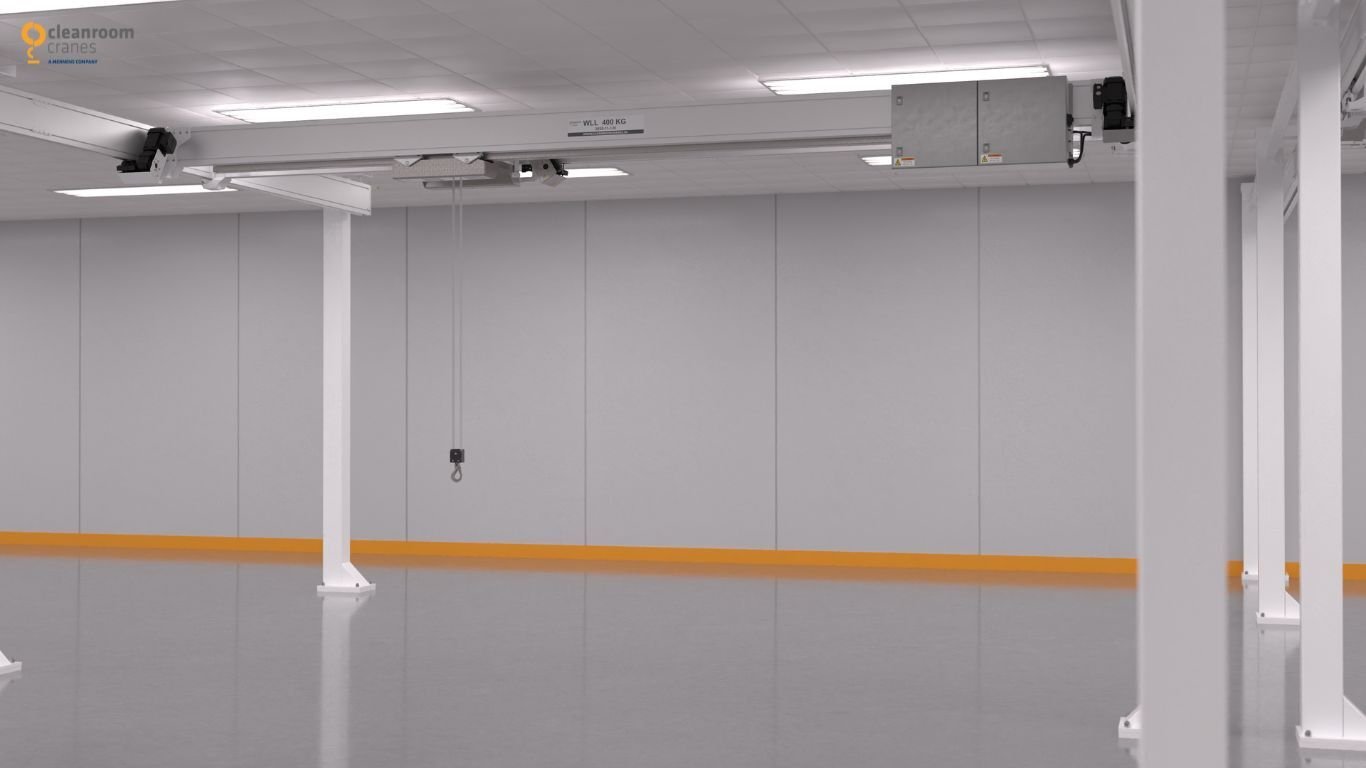
Lightweight crane

When is a lightweight crane system the right choice?

The choice of a lightweight crane system is influenced by factors such as working load limit (WLL), duty classification, process intensity, span requirements, positioning accuracy and ergonomics. Where these requirements can be met by a lightweight system, it is often an efficient and practical choice.

In cleanrooms, lightweight systems are commonly used for assembly work, handling smaller components and supporting R&D activities, where flexibility, precise positioning and ease of use are important. Applications involving higher working loads, larger spans or more intensive use typically require a crane system designed for those demands.
The right choice starts with the process

Not every cleanroom places the same demands on lifting and positioning. In one environment, the focus may be on handling delicate components with a high degree of accuracy. In another, large modules need to be installed within a restricted building height.

That is why crane selection starts with understanding both the lifting tasks and the available space within the process. Questions that are typically considered include:

• What loads need to be handled?
• What lifting capacity, positioning accuracy and usage frequency are required?
• Is a lightweight crane system suitable, or does the application require a more robust configuration?
• What hook height and lifting range are available within the facility?
• Would a single-girder or double-girder crane be more suitable?
• Which cleanroom classification applies to the environment?
• Are future process expansions expected?

The answers help define the required capacity, crane configuration, control system, cleanliness level and overall design.

Looking at the process first helps identify which crane configuration fits the application best. It also makes it easier to accommodate future changes in production requirements or facility layout.

Contact us for a technical assessment of the possibilities within your cleanroom environment.


More news

Blog Image :

MCC cleanroom lifting solutions VCCN lecture

On June 17, 2026, Danny van Deuzen will present a lecture at the National Symposium Contamination Control. He is Commercial Director at Mennens Cleanroom Cranes and specialises in lifting solutions for controlled environments.

Read more
Blog Image :

When handover is more than a signature

A cleanroom crane must not only function technically but also demonstrably meet all requirements. This blog explains how the final inspection and digital handover are organized, with emphasis on transparency, control, and quality assurance.


Read more
Blog Image :

MCC & Marketech at SEMICON SEA 2026

Mennens Cleanroom Cranes will participate in SEMICON Southeast Asia 2026 in Kuala Lumpur. The company will be present in collaboration with Marketech International Corp (帆宣系統科技股份有限公司). The focus is on cleanroom lifting solutions for semiconductor and high-tech production environments.

Read more
Blog Image :

Mennens Cleanroom Cranes R&D Center for lifting system validation

With the opening of its Research & Development Center (R&D), Mennens Cleanroom Cranes (MCC) now has a dedicated environment where cleanroom lifting systems are developed, tested and validated under controlled conditions.

Bringing these activities together in one location provides deeper insight into system performance, behaviour and component interaction. This directly supports informed design decisions and effective project execution.

Read more
Back to overview

Get advice

Our experts are ready to assist you.

Contact image 414x414 (1)

Need customization?

Contact image 414x414 (1)

Mennens Cleanroom Cranes B.V.

Achtseweg Zuid 161
5651 GW Eindhoven
The Netherlands
T +31(0)88 425 83 00
sales@cleanroomcranes.nl
www.cleanroomcranes.nl